Edit
After discovering how to exploit the capabilities
of applications and the system, it’s time to create scripts.
As scripts consist of text in the form of code, the Editor is
therefore a critical component of any scripting tool. Script Debugger’s
powerful code building and editing tools keep you focused on your work.
The editor supports Mac OS X text editing conventions, from emacs key
bindings to services, and beyond.

(click images to enlarge)
Powerful Code Building Tools
Improve
productivity and develop scripts more quickly and easily with Script
Debugger’s powerful and flexible code creation features. Insert
tell blocks and more complex code from almost any window. Script Debugger's ‘clippings’ intelligently
insert code ranging from AppleScript constructs (such as repeat loops), to basic
tell blocks, to application commands (including parameters). Clippings wrap around
the text that you have selected. It’s also simple to create your own clippings.
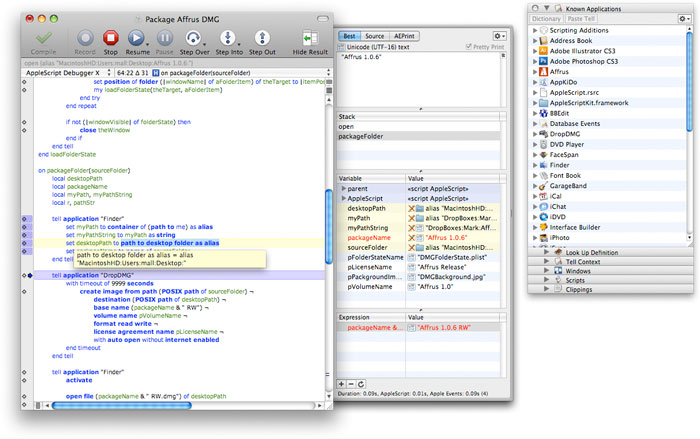
Script Debugger streamlines the development process
with its tight integration of all components of the application. The
Editor, Dictionary Browser/Explorer and Known Applications, Look Up
Definition and Tell Context Inspectors all work together to provide
a complete solution. Drag elements from the Finder, or from Script
Debugger’s
windows in the Editor, to insert Tell blocks. Special buttons in these
windows also insert code. In the Editor, quickly and easily perform
many common editing tasks using Contextual menus. They also provide
access to Look Up Definition for selected terms and clipping and tell
block insertion.
The
Known Applications Inspector lists all the commands and events for each
application that it contains. In addition, it displays this information
for applications that aren’t currently running (AppleScript requires
an application to be running when browsing its dictionary). Drag a function
or command into a script and it inserts the tell block and parameters.
For example, it inserts the complete code for duplicating a Finder item
when dragging the Finder’s 'duplicate' function
into the script (or when using the Paste Tell button with that function selected).
Tight
Application Dictionary Integration
View only the relevant dictionary information
about what’s
selected in the editor using the Tell Context inspector. Selections in
the Editor influence what appears in this inspector. Changes in the script
immediately affect its content. Explore the effect of changing ‘whose’ clauses
because this inspector is dynamic. For example, when scripting iTunes,
see all the information about ‘playlist whose name is ‘My
Top Rated’’ and change
the name to see how iTunes responds.
Find
terms no matter where they are located with the Look Up Definition Inspector.
It’s similar to Search Dictionary
but permits searching multiple dictionaries and Scripting Additions
simultaneously. The Look Up Definitions inspector offers fine-grained
control over which Dictionaries to search and what type of element
to be found. Specify any or all of the types to search: Suites, Commands,
Events, Classes, Records, Enumerations and Types, as well as any or
all parts of the Dictionary entries: Names, Descriptions, Synonyms
and Apple Event Codes.
Flexible Code Presentation
Control the appearance of
the script in the editor, from formatting for various parts of AppleScript
to visually identifying spaces, tabs, returns and other invisible characters.
Easily identify location (even for very long scripts) using Display line
numbers in editors. Other items that help create and navigate the script
include searching the script, Table of Contents menu, providing rapid
access to globals, properties and handlers, and script objects. Identify
block nesting problems or select elements of scripts in a structured
fashion from the ‘inside
out’ using brackets, braces, parentheses and other AppleScript structures
(such as repeat loops and handlers) using the Balance command.
Explore | Edit |
Run & Debug | Deploy | What's New In 4.0 |
My SD Story
|