|
|
|

|
Known Applications Inspector
|
|
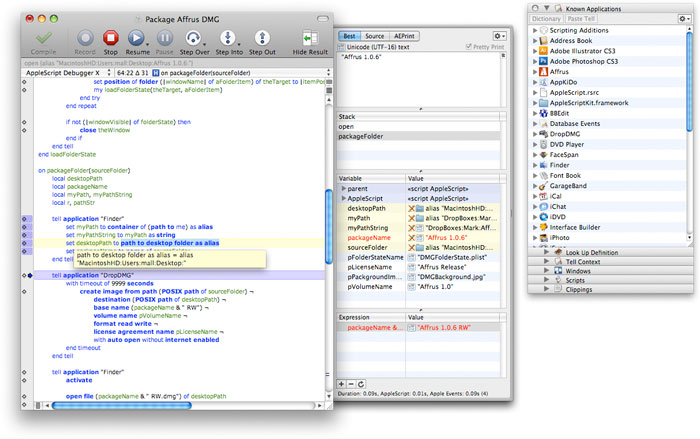
The Known Applications inspector lists applications that Script Debugger has “met” in various ways. This list appears in several places in the interface — for example, in the File > Open Dictionary menu and the Edit > Paste Tell menu. From the Known Applications inspector, you can manipulate the list, as well as perform the two main actions that the list is good for.
To open an application’s dictionary, select it and click the Dictionary button, or double-click the application’s name.
To insert a tell block targeting an application, select it and click the Paste Tell button. Hold down the Option key to create a new script window at the same time.
Alternatively, drag the name of an application from the Known Applications inspector into a script window.
To learn an application’s location, hover the mouse over it to see the tooltip.
To show an application in the Finder, select it and choose Reveal Application from the tool popup in the upper right corner (or the contextual menu).
To remove an application from the list, select it and choose Forget Application from the tool popup (or use the contextual menu). (You can also choose Forget All Applications to empty the list.)
To add an application manually to the list, choose Add Application from the tool popup (or the contextual menu).
To toggle the visibility of icons in the list, choose Hide / Show Icons from the tool popup (or the contextual menu).
The list also provides access to AppleScript commands that you can use in your script when targeting each application. To see them, click the disclosure triangle next to the application’s name. Then:
To look up a command’s definition in the dictionary, select it and click the Dictionary button, or double-click the command.
To insert a command template into your script (including a tell block, if necessary), select the command and click the Paste Tell button (or drag the command from the Known Applications inspector into a script window). Hold down the Option key to create a new script window at the same time.
You may be curious about how the Known Applications list is automatically populated. The answer is a little complicated, but here’s the short version. An application is added to the list automatically:
- When Script Debugger is first installed (it looks on your computer for certain “well known” scriptable applications, and adds them to the list if they are present).
- When an application’s dictionary is explicitly opened.
- When an object specifier is explored (so, for example, when you target an application in a script and it returns an object as the script’s result).
- When a tell block targeting that application is detected in your code.
Running a script targeting an application might not add that application automatically to the list. The reason is that AppleScript and Script Debugger are two different entities, so AppleScript can run a script without Script Debugger seeing and analyzing the contents of that script.
Explore | Edit |
Run & Debug | Deploy | What's New In 4.5 |
My SD Story
|