|
|
|

Scripting Beyond the Office
Phillip Brackett first heard about Script Debugger during the AppleScript
Pro Sessions in New Orleans in 2002. He, in fact, won the copy of Script
Debugger that was offered as a door prize. “I began working with
it on the train ride home,” he recalls. “I used it exclusively
for about a year, basically cutting my teeth in the scripting world while
implementing it. Then it happened, I had to edit one of my scripts on
a computer that didn’t have Script Debugger,” he explains. “My
script was a droplet so I was dragging a text file onto the open script.
After trying this repeatedly, I finally realized that Script Debugger’s
ability to recognize handlers from within a script was not ubiquitous,
as I had assumed, but part of the inherent power of Script Debugger.” He
is less casual now in assuming that one application is like another when
it comes to scripting. “I have never had a reason to even
look anywhere else.”

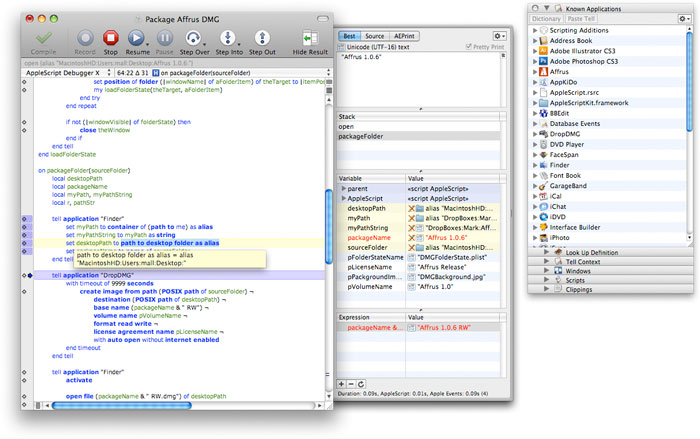
Phillip Brackett signs off on a custom print job successfully
implemented using Script Debugger 4.0.
In his professional life, Phillip uses Script Debugger
to automate InDesign at a printing company. “It’s
my exclusive scripting interface,” he says. His department
creates the covers for the various items that are printed, which require
multiple trim sizes and bind types. His scripting takes the finished
artwork and builds the InDesign file around the artwork so that the result
conforms to the print floor specs. “Digital presses produce work
differently than offset presses so templates are produced to varying
parameters based on book type variables,” he explains. “These
variables are accounted for within my scripts.”
In addition to Script Debugger’s role at work, Phillip does “all
sorts of fun stuff” with it in his personal life. He, for example,
used Script Debugger to generate a contact sheet for his digital photos, which
he wrote when only Photoshop offered a solution. While other solutions are
now available, he prefers his as he can add custom conveniences such as a check
box for each picture so that he can check the ones that he wants. He’s
also able to customize fonts and page headers to identify photo groups. For
his son, he wrote a script to produce a multiplication table quiz on the tables
that his son requests. It re-quizzes him on any misses and has a timer that
he can choose to use as the script begins. For his wife’s retail business,
he created a script that generated an index card (from a spreadsheet), containing
the appropriate sales information. The script also generated a barcode with
pertinent information embedded so that items could be scanned at the checkout
into a cash register that a friend designed.
While he was a total novice when he won that copy of Script
Debugger, he believes that skill level is mostly irrelevant. “Any
problem in using Script Debugger was actually my lack of familiarity
with scripting,” he says.
He doesn’t recall where he heard about AppleScript. He was using
it, though inefficiently, prior to attending the AppleScript Pro Sessions. “I
think it was an ever present reality but out of reach,” he says. “When
I began scripting, I was aware of what its capabilities must be, but
wasn’t realizing that potential.”
Now into his fourth year of using Script Debugger, Phillip had only
one occasion to call for technical support. “I began to have some
problems with version 3.0.6. I had no clue if the problem was with Script
Debugger, my computer, or one of the reference applications in my scripts.
I called Late Night’s technical support and was calmly and intelligently
walked through a process to help me determine where my issue resided,” he
says. “I don’t remember what the resolution was. What I do
remember is the effort expended to help me resolve my problem. Script
Debugger itself is a great product, but the technical support is equally
impressive."
Explore | Edit |
Run & Debug | Deploy | What's New In 4.0 |
My SD Story
|