|
|
|

What's New In Script Debugger
4.0
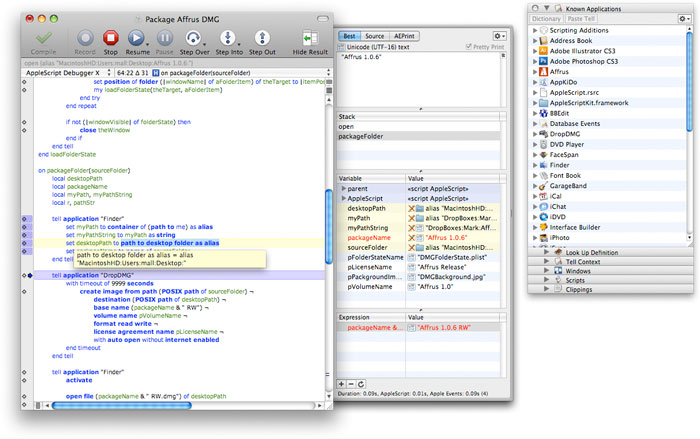
Simplified User Interface
Script Debugger 4.0’s simplified User Interface
displays more information in a smaller space and takes greater advantage
of the wide-screen displays on recent Macintosh computers.
Script Debugger 3.0 had seven kinds of windows
(Script editor, Value Viewer, Result Viewer, Apple Event Log, Properties & Globals, Expressions,
Dictionary and Explorer). In version 4.0, this has been reduced
to four (Script Editor, Viewer, AppleEvent Log and Dictionary). Along
with the reduction in windows that you have to manage, each of them has
been redesigned to reduce clutter while at the same time displaying more
information.
Concurrent Script Execution
In Script Debugger 4.0, you can run and debug more
than one script at a time, enabling you to debug interactions across
scripts.
Modern File Formats
Script Debugger 4.0 supports all AppleScript
file formats, including the new bundled formats introduced in Mac OS
X. It also supports
long file names and Unicode characters in file names.
Improved Script Editor
The redesigned Script Debugger 4.0 script editor
window offers a more feature rich environment for creating and editing
scripts. Improvements
include:
- The Table Of Contents menu has been revised to better represent the
structure of complex scripts.
- The editor can now display invisible characters, line number, tab
stops and indentation.
- Script source code can now be displayed in «chevron» syntax
(requires Mac OS X 10.4 or later).
- The addition of a new AppleEvent history menu that lets you quickly
re-execute AppleEvent handlers.
- The addition of a new Lookup Term inspector and Find Definition command
to find application terminology definitions in application and scripting
addition dictionaries.
- Improved handling of dropped files in editor. Script
Debugger 4.0 offers several new options for pasting file paths (paste
Alias, HFS path, POSIX path, or Finder object reference).
- Clippings can now wrap existing code and control text selection through
a simple tagging language.
- Tell blocks can now paste directly into scripts
from the Edit menu (or from the script window’s contextual
menu).
- The script’s description is included
when a script is printed.
- The Applications inspector can display command or event handler templates
directly into scripts.
- The editor responds to applescript://URLs for inserting sample code
from web pages.
Improved Value Viewer
The functionality of Script Debugger 3.0’s Viewer
and Inspector windows has been combined into Script Debugger 4.0’s
Value Viewer that can explore object specifiers and view images. When
viewing file references, Script Debugger displays the file’s icon
and shows the file path in three formats (HFS path, POSIX path or Finder
object specifier).
Improved Debugging
Major improvements in Script Debugger 4.0’s
AppleScript debugger include:
- Break-On-Exception now pauses script execution
at the point where an exception is thrown. This lets you examine
the cause of an error, including the value of all variables at the
time the exception was thrown.
- Code-Coverage display is now more readable.
- Breakpoints are now persistent when using external debugging capabilities.
- An execution timer has been added.
- Tooltip expression evaluation has been improved (e.g. hovering over
a (){}[] character evaluates the entire sub-expression).
- AppleEvent Log entries link to source line that generated the event.
Improved Dictionary Window
Script Debugger 4.0’s dictionary window has been re-implemented
to take advantage of the latest Mac OS X technologies. As part
of this re-implementation, the user interface has been reworked and provides
the following benefits:
- Supports Mac OS X sdef dictionary meta-data which provides much
more usable scripting dictionaries, including expanded documentation
and sample code (where provided by application developers).
- Unified Dictionary Explorer/Value Browsers can
now ‘explore’ external
object specifiers no matter where they appear (in variables, dictionaries,
error values, results, etc.).
- Application dictionary display has been completely restructured
to make dictionary information simpler to understand and navigate.
- Dictionary searching (intra and cross-dictionary).
- Dictionary display includes command and event
templates that can be copied and pasted into your code.
- Sophisticated ‘aete’ ->sdef
conversion (significantly better than that performed by the Tiger
Script Editor). No other scripting tool extracts as much information
from old-style dictionaries.
- Hyper-linking in dictionaries that allows you to jump to related
definitions.
- Where-Used links in dictionaries to find where data types/classes/records
or enumerations are used.
- Modernized Open Dictionary menu, making it easier to open
dictionaries.
- Applications palette can generate command and event templates.
- Paste Tell command lets you create tell blocks for any running
application; paste command and event handler templates.
Manifest Improvements
The Manifest command (that lists the applications
and scripting additions on which your scripts depend) has been improved
to list the specific commands that your script uses.
Other Improvements
In addition to the extensive list of new features
above, Script Debugger 4.0 also offers:
- Simplified preferences panel.
- Redesigned inspector (floating palette) management,
making it easier to use all of Script Debugger’s inspectors,
even on smaller screens.
- The inclusion of JavaScript OSA 2.0, allowing you to script in JavaScript.
Explore | Edit |
Run & Debug | Deploy | What's New In 4.0 |
My SD Story
|